
Master the ECE Fundamentals Without the Screen Fatigue
While Early Childhood Education is often simplified by those outside the field, practitioners recognize the immense complexity of the work. To succeed in this discipline, you must discover the principles, practices, and strategies for teaching young children from birth to 8 years, a developmental phase that requires equal parts scientific understanding and pedagogical art.
The challenge for the modern student, however, is the sheer volume of foundational theory. When navigating a 400-page digital text, “screen fatigue” is not just a nuisance; it is a barrier to genuine retention. There are only so many hours one can spend staring at a PDF before the nuances of “Theoretical Perspectives” begin to lose their clarity. This audio version of the Foundations of Early Childhood Education WisTech Open textbook provides a necessary alternative to the traditional desk-bound study session.
By converting the full OER curriculum, from the landmark theories of Montessori and Vygotsky to the contemporary ethics of classroom management, into an immersive auditory format, we’ve empowered you to reclaim your schedule. Whether you are commuting to a clinical practicum or managing the daily demands of life, you can now internalize the core tenets of your future profession without being tethered to a monitor.
Through the “Bimodal Edge,” you are doing more than just listening; you are reinforcing the material through a secondary neural pathway. From the historical heavyweights in Chapter 2 to the critical family partnership strategies in Chapter 8, Audileo ensures that the curriculum is accessible wherever you are. Do not merely read about the evolution of education; experience it.
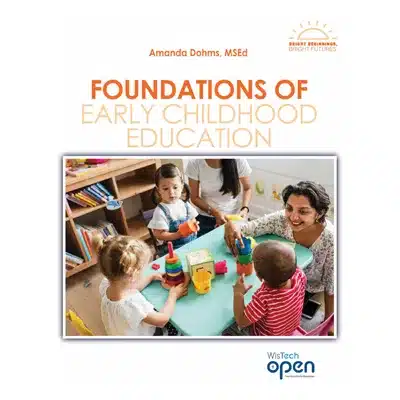

- Audiobook duration: around 5 hrs
- Textbook Publisher: WisTech Open
- Audiobook Publisher: Audileo
What’s Inside: The Full ECE Foundation
Chapter 1: The ECE Professional – Exploring the roles, responsibilities, and the “why” behind your career choice.
Chapter 2: Historical Perspectives & Theorists – From Froebel to Montessori; understanding whose shoulders we’re standing on.
Chapter 3: Types of Programs & Delivery Models – Navigating the landscape of Head Start, private centers, and family childcare.
Chapter 4: Child Development & Learning – The “meat” of the course: physical, cognitive, and social-emotional milestones.
Chapter 5: Creating Inclusive Environments – Designing spaces that welcome every child and foster actual belonging.
Chapter 6: Curriculum & Instruction – Moving beyond “play” to intentional, evidence-based teaching strategies.
Chapter 7: Observation, Documentation, & Assessment – Learning how to see what children are actually telling us.
Chapter 8: Building Relationships with Families – The essential bridge between the classroom and the home.
Textbook editor: Amanda Dohms
Textbook authors: Katie Steffes, Nora Ziburski, Amanda Dohms, Mary Beth Boettcher, Tracy Jacobson, Christine Spang, Sara Horstman, Vicki Tanck